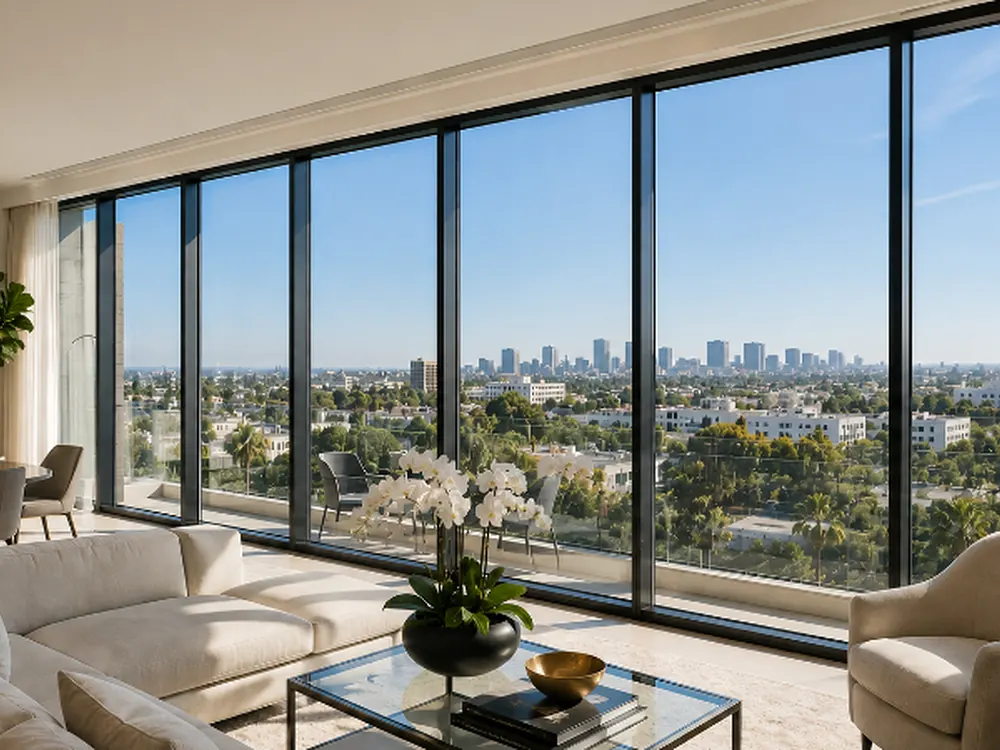
Almost every Conejo Valley home we assess has the same layout and the same complaint. There's a two-story volume with a wall of glass pointed at the view, the air conditioning runs continuously from noon, and upstairs is still unbearable. The building is not broken. It's doing exactly what its geometry requires.
The thermostat is in the wrong place
Heat rises, which everybody knows and almost no floor plan accounts for. In a two-story great room, solar energy coming through the tall glass warms the air, that air climbs to the top of the volume, and it sits there — in the loft, the upstairs hallway, and whichever bedrooms open onto the space.
The thermostat, meanwhile, is on the ground floor at head height. It reads a room that's being actively cooled and reports that everything is fine, so the system keeps running to satisfy a downstairs setpoint while the upstairs climbs. You end up paying to cool a space that's already comfortable in order to not-cool the one that isn't.
Why it's worse here than in the city
Two things stack up. The Conejo Valley sits inland and above the marine influence, so summer afternoons routinely run past a hundred degrees with no coastal relief — the temperature at four o'clock in Newbury Park can be twenty degrees higher than in Santa Monica on the same day.
And the homes here were designed around the view. Hillside lots in North Ranch, Lang Ranch, and Dos Vientos put the glass where the hills are, which is very often west or southwest — the two worst possible orientations for afternoon heat. The feature that sold the house is the feature causing the problem.
What film actually delivers on tall glass
Treating the upper glass is disproportionately effective, because that's where the energy enters the part of the volume that's overheating. Here's what a properly specified film does on a problem exposure:
- Up to about 80% of infrared heat rejected — the part you feel as room temperature.
- Ultraviolet cut by 99%, which halts the fading of floors, rugs, and anything hanging on a wall.
- Glare cut enough that screens are readable with the blinds open.
- Cooling systems that cycle instead of running continuously all afternoon.
What it won't do is turn a greenhouse into a cellar. Film reduces solar gain through glass; it does nothing about heat coming through an under-insulated roof or a west wall, and it cannot fix an undersized AC system. Any installer promising a specific number of degrees without looking at your house is guessing.
The access question nobody quotes for
Tall glass needs staging, a second installer, and considerably more time per pane than a standard window. This is the most common reason a suspiciously cheap quote turns into a change order halfway through the job, or worse, an installer working off a ladder at a height where they shouldn't be.
When you compare bids, check that the high glass is actually in the scope and that access is included in the price rather than listed as a to-be-determined. Ours is quoted with staging in the number, because there is no version of this job that doesn't need it.
The dual-pane warning
Nearly all glazing here is dual-pane, much of it low-E, and film selection on those units is a calculation rather than a preference. The wrong product raises the outer lite's temperature enough to cause a thermal stress crack, and voids the glazing warranty at the same time.
This is the single most common way a cheap film job becomes an expensive one. We run thermal stress numbers on the actual glass before quoting, every time. If you're collecting bids, ask each installer what they've assumed about your glass makeup — the answer tells you most of what you need to know. Get a free assessment and we'll tell you exactly what you're working with.